Saturday, 1 September 2018

A New Season

August 2018

A New Season


As the new football season begins, the hot summer starts to cool and gives some rest bite from heavy watering. Although keeping the turf watered is essential, by doing this can also cause some side effects...

 
 Now the renovated pitches are approximately three months old and doing well after the grow in, some of the consequences of heavy watering are beginning to show. We are seeing a little more Poa Annua grass species among the ryegrass than usual. It's no surprise and something we have to battle to some extent every year.
Annual Meadow Grass (Poa Annua) in some training pitches

We are now verti cutting every couple of weeks to clean any seed heads out and applying a silicon based product to the turf to also help to stand the leaf and seed head up so the mowers can remove the seed. Having poor characteristics and performance for sport, it is important to control The Poa from spreading.

We have also seen an increase in Knotgrass weed, which I expect is due to the unusual weather we have had this summer. As a rule, we don't spray selective weedkillers, but as we walk over the pitches so much knocking back after training, we can hand weed them before they become too much of a problem. Notice the large tap root on the photo. We have had some reaching 10 inches down!

Knotgrass weed


Another consequence of heavy watering is black layer. Water fills the pore spaces instead of air and anaerobic conditions are present producing hydrogen sulphide gas, which is poisonous to the roots. Smelling the soil can detect anaerobic activity which will give an eggy smell, rather than a clean soil which will smell sweeter. Increased aeration and back to a normal watering regime will likely solve this. We tend to aerate approximately every 14 days alternating between 12mm tines at 7-9 inches and 20mm tines to 10-13 inches.

Soil Profile of Pitch 6 (training ground match pitch) showing a little blacklayer
During the very hot weather we held off applying the Primo Maxx growth retardant as it can stress the turf more if it is under some sort of other stress. This year our first applications were at the end of July and we shall carry this on until the temperatures drop below double figure, usually sometime in October.
Our Primo Maxx programme has slightly changed from one monthly application of 0.8 l/h to fortnightly applications of 0.6 l/h. This is with a view of keeping the product consistently active in the plant instead of it wearing off after about 3 weeks the giving it another hit on the fourth week. Although we have increased the monthly amount by a third, we haven't noticed any major reduction in growth, but certainly a more consistent growth.

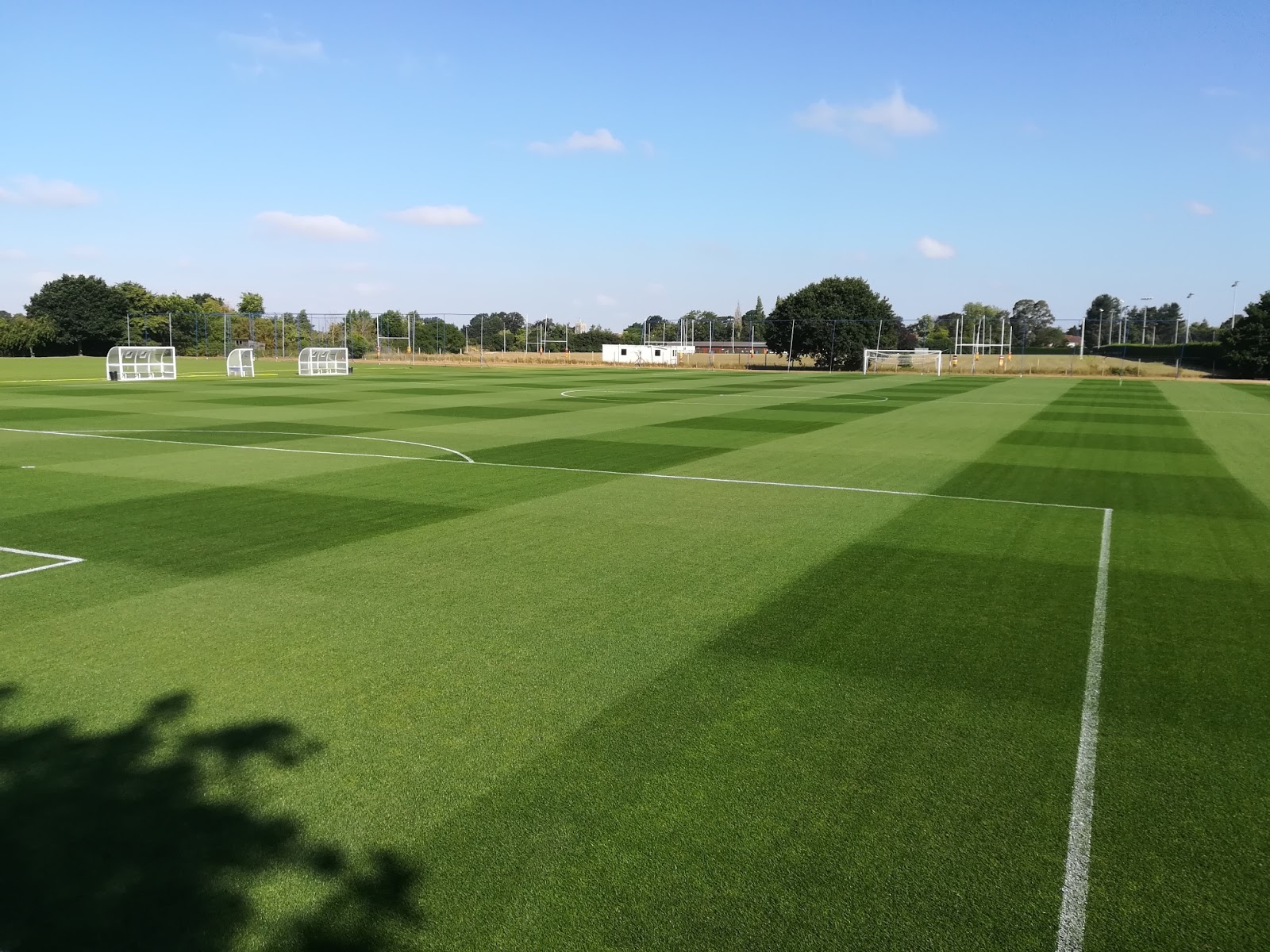
First league game versus Blackburn Rovers


We are currently playing U23's fixtures at Portman Rd, with the plan of getting our 5 compulsory stadium matches played during the growing season so we can gain some natural recovery. This year we have not entered the U23 cup, which is in a mini league format and games must be played at the stadium. We don't have any choice over the dates they are played and last year left a problem when the home fixtures were scheduled in January and February. Along with other fixtures falling awkwardly, this left us with more games than the stadium pitch can cope with at that time of year, mixed in with poor weather.
We could play the U23 games at another stadium to spread the usage, but given the remote location of Ipswich, There isn't a non league stadium within a 25 mile radius, as per league/cup rules, which has the required facilities to host the fixtures.


We continue to work on the pitches to make them as strong as we can going into the Autumn and Winter, we appreciate the good times and plan as well as we can for the more challenging times ahead.




Wednesday, 1 August 2018

Heat Stress

July 2018


Heat Stress

With temperatures around 30 degrees Celsius for much of the month, it wasn't only the turf which was suffering from heat stress! irrigation breakdowns and high winds made it a challenging month.

I usually welcome the warm summer months, the pitches are at their best at this time of year and I feel I have more control over the pitches as they are growing and their health can be controlled easier with applications of products, water and mechanical operations.

This summer has been different, with no rain for 9 or 10 weeks, temperatures more than 10 degrees warmer than the rye grass plant thrives on, the pressure has been on to not miss a square inch of the pitch when watering or it shows up within a day or so due to the intense heat.

Heat stress caused by irrigation missing areas due to wind


With most pitches being on a semi automatic or fully automatic watering system, it shouldn't be too difficult to keep the pitch area watered - until it gets windy...
The wind was strong for much of the early part of the month, leaving some areas of the pitches with drought stress. Some early morning hand watering was required to try and catch up on these areas, hoping enough went on to see it through the day.
With such a long period without rain, the ground water has diminished with reduced amounts being drawn at the training ground and no water at all being taken from the bore hole at the stadium. We have the ability to switch the mains on and off as required, but it does come at a cost.

Pitch 6 holding up well after the first run of games


On some days when it has been really hot, we have missed cuts on the pitches to reduce the stress on the plant and avoided putting products down which may cause problems in the continued heat. 

Primo Maxx application at the end of July


Only at the very end of the month once the temperatures have fallen to just above average for the time of year has the growth retardant, Primo Maxx been applied to the stadium pitch. Like many stadiums, Portman Road has its own micro climate. the wind is stronger in certain parts of the bowl and it tends to swirl. It is certainly hotter in the summer than outside of the stadium and colder in the winter too. For this reason, the first Primo Maxx application has been held off longer than normal. The stadium pitch is now 9 weeks from seeding (23rd May), and the first application has now been made. Energy from the plant is redirected from the upward growth into creating plant density and increased rooting. It also reduces the amount of poa annua seed heads which can show up now.

The first use of the Stadium pitch is always at open day, which is a training session on the pitch in front of the fans. It is our first chance to see how the pitch performs. We are generally looking for evidence of the strength of the plant/rooting or lack of it which will be shown up quickly!

Pre-season friendly 28/07/18


As we have don't have any reinforcing fibres in the pitch, it is vital we work on root development as much as possible. coupled with a comprehensive aeration programme, we are applying products to the pitch regularly to encourage root development. We are also looking at more products which are trialled at the training ground to see if there is something better on the market we can use on the stadium pitch. As a rule, we don't try anything out at Portman Road unless it has proved its worth at the training ground first.

Two days after the open day, we had our first home pre season friendly, which is more full on for the turf than a training session. Tackles aren't held back and the twisting and turning is a good test to see where we are at.
Due to the first league fixture drawn at home on 4th August, the pitch was aerated 5 days before the friendly held on 28th July, which leaves the pitch a little on the soft side, so some damage was expected but I was pleased with how the pitch came through. The pitch will play a little firmer going into the first league game, then a two week gap in fixtures, so we will once again be able to relieve any consolidation in the soil created by the mowers in the build up to the game.

The Training Ground kept well watered in the heat


All in all, a hot summer is preferred to a cold winter every time, and we should be grateful for the irrigation we have, even if the wind does cause havoc now and again.

Tuesday, 3 July 2018

The Grow In

June 18'

The Grow In


After spending a long week renovating, the task of furiously growing in the pitch to reach a pristine condition begins.

If all has gone to plan and the sun has shone, we should be "match ready" in about 6 weeks. This year, we had germination on the stadium pitch in 6 days. after another week, we are mowing every day.
This years seeding was delayed because of a cinema screening on the pitch. As this would have coincided with the seed germinating, I delayed seeding for a few days so it came through after the pitch was clear.
Cinema screen post renovation but pre seeding

As soon as we are able to get a sprayer on the pitch, we will apply our liquid fertiliser package at a low rate every 7 days, continuously drip feeding until we are happy that we've grown in successfully then drop back to a fortnightly spray of a seaweed and molasses/ trace nutrient application. Granular feeds are applied approximately every three weeks and a slow release every 3 months.

Early signs of germination


We use a wetting agent called Qualibra on the stadium pitch to help the moisture applied spread evenly throughout the profile. this should help to avoid dry areas and to encourage the root system to develop.
Mowing every day continues throughout the growing season, with the height of cut gradually being reduced from 28mm to 25mm after the pitch is a few weeks old. We take care to make sure the plant leaf is cut cleanly as it is a vulnerable time for the turf, with it being susceptible to disease outbreak. With so much sand around the blades sharpness gets dulled quickly leaving the leaf being pulled or torn instead of cut. We have spare mowers being sharpened whilst the good ones are being used and as soon as we need to we can swap them over so the turf doesn't suffer.  
35 days after seeding

With the weather at the end of May and through June being so hot and humid, we have suffered from some disease outbreaks at the training ground during our grow in. We have suffered from an outbreak on 4  different pitches, suspected to be brown patch. Of the four pitches, three had different suppliers seed on them so it wasn't just a certain cultivar which was particularly susceptible.
Pitch 6 with disease

Pitch 6, 8 weeks after renovation


Although I am trying not to spray fungicides, due to the importance and the tight time scale to grow the pitches back in, applications were made to two of pitches most affected. Fortunately, these areas have now recovered and can hardly be seen where the damage was. As we are at the time of year where the turf is actively growing, good recovery is possible. During the winter, a bad outbreak of leaf spot can be more of a problem.
By the end of June, we are getting a pitch coming back into play every week and by the end of July all renovated pitches will be back in use as the Academy will be raring to go.
What to do with all the turf taken off the pitches during the renovation? We are currently levelling this out on unused land on site, so we are able to let it settle and tip on top next year. some of the soil which is collected on our second pass of the pitches is kept aside to dress certain areas like the goalkeepers training area as they don't like straight sand being used as this can cause splash into their faces whilst training.
Levelling of the pitch arisings

Now that renovations 2018 will soon be behind us, we are looking forward to seeing how the pitches perform in training and knowing whether our 6 week grow in has been a success. 

Friday, 1 June 2018

Stadium Renovation

May 2018


Stadium Renovation

I love this time of year as we put the Winter behind us and start afresh with newly renovated pitches, which will soon be looking their best for the beginning of the new football season.

Planning for renovations starts soon after the previous one has finished. Firstly,  dates for the start need to be agreed. This will depend on hiring out the stadium for corporate events, county cup finals and concerts. 
I start by working out the date for the expected first use of the pitch and work backwards. I aim for 8 weeks from the start of the renovation to the first football use, therefore giving 7 weeks to grow in, which should be adequate if all goes to plan.

Leading up to the proposed start date, I keep a close eye on the weather as this could cause delays to the stripping off of the pitch surface. The arisings are taken away from the stadium by a grab hire company, so they need to be notified if there is any change of plan. I also hire in a JCB digger so we can load the sand into the spreader more quickly, so the delivery needs to be taken into account.

The pitch is sprayed off with Glyphosate to kill all vegetation. I don't want any recovery from the old sward which could be our desirable rye grass or the undesirable annual meadow grass (poa annua). Although by fraze mowing (using the Koro at a shallow depth), the removal of the poa can be achieved, leaving the rye to regenerate. This is possible as the crown of the Poa is above the surface and the rye below.


I use four staff for the beginning of the renovation. One Koroing, two catching and the fourth to keep tidy any bits we spill on the pitch and helping tip/keep tidy out in the car park where we dump the surface of the pitch.

The first few runs of the koroing is to get the right settings on the depth of the machine. After that it should be plain sailing across the pitch. I try not to hurry though, as we want to do a clean job. We aren't under pressure to get done as soon as possible as we are not contactors needing to get onto the next job, but we do work as efficiently as we can.


Natural soil based surface built on an old rubbish tip. A bike wheel has been pulled up in the past. A brick exposed this year.


On day 1, the first pass of the surface is removed. Day 2, a second pass is made at a slight angle to clean up anything that hasn't been picked up, but this is just a skim. we remove 15-20mm in total.
When we are half way across the second pass, we drop one tractor/trailer off from catching as there is less surface being removed.

87 tonnes of sand being applied


We then start to dress the sand on the pitch. The first third of the pitch is completed first so there is something for the Blec Groundbraker to start working on. at this point the koroing is complete, which will free up two tractors.

Groundbreaking and Veti-draing


we use a small Iseki TXG237 with a greengroomer "zig zag" brush to drag sand down the crevices the groundbraker (linear aeration) has made, this helps to aid drainage. we then follow with 1" tines in the verti-drain and do the same with the brush to work the sand in the verti-drain holes. We usually have to do two passes with the verti-drain to lose all of the sand. We apply 80 tonnes to a full size pitch, but as we have 3x29 ton delivery's to the stadium we have an extra 7 tonnes to lose in the pitch compared to the training ground due to lack of long term storage at the stadium.


Sand is brushed into the slits which are about 7 inches deep


Once, the sand has been brushed down the holes, there should only be a dusting left. if too much sand is left on the top, it will cause problems later in the season with the layering effect.


next, seeding is done in three directions. passes are done at 11 o'clock, 12 o'clock and 1 o'clock. this allows the seed to grow in between the 3.5cm the seeder discs are spaced at.
Approximately 20-22 bags are applied, at a rate of around 60g SqM. This year we have Johnson's Prem Pitch pro nitro. I'm still considering the benefits or not of coated seed, but that's for a discussion at another time..

Straight afterwards, an application of sierrablen slow release and conventional pre seeder 8-12-8 fertiliser is made. 
Watering is then set on a timer for 4 short cycles per day to prevent seed wash. This is done until germination has taken place, then the irrigation time is increased and the frequency reduced.

At this time of year, I'd expect germination in 5 or 6 days with its first cut after 12-14 days.


Tuesday, 1 May 2018

Renovation Begins

April 2018

Renovation Begins


Is it just me, or have we had all four seasons in the last month? Freezing temperatures, then summer happened for about 10 days, to finish the month, High winds and heavy rain fall. Is this a blip or are we seeing a change in annual weather patterns?


Renovations began in earnest on 16th April with the first two small pitches being Koro'd off. I'm always a little apprehensive at the beginning of the renovations when the kit comes out of the shed as to whether we will pick up mechanical problems as it hasn't moved for 9 months. We always have a service and a mechanic will look over them, but until you start to actually use them on a full days work, you never know..

Due to the early start in renovations and with the weather usually a lot cooler during April, I opted to sow a perennial ryegrass tetraploid 50%/diploid50% mix as the tetraploid seeds are advertised to germinate quicker at lower temperatures and from soil temperatures of 4 degC.
As it turned out, we were having a mini heatwave and soil temperatures had risen to over 18 degC. We had germination in 6 days... usually we are around two weeks before we see anything at this time of year.


Once the surface is removed, approximately 12kg per SqM is applied. This works out around 80 tonnes per full size pitch.
The next job is losing it in the pitch. I opt for two methods. Firstly, the groundbreaker (linear aeration) goes over creating lines for the sand to fall into. Secondly, the pitch is vertidrained with 1 inch solid tines and then the sand is brushed into the holes. This method has helped the drainage of the pitches no end over the last few years. (Detailed renovation next month!)
All pitches are planned in to which week the renovation will begin on them so I have a pretty good idea to which week they will be available to use once the Academy and senior teams return from the summer break.
Typically, once the irrigation was started up, faults appeared. Even though we get fully drained down on the Academy pitches for the Winter to prevent the pipes freezing up and cracking, something is usually a problem. something usually electrical! 
I am planning for the upgrade of the system to run on only pop ups, so no need to pull hoses out onto the pitch for watering. this has been completed on three pitches so far - 9 to go.


The stadium pitch is looking back to what it was pre Winter, albeit with a lot of poa annua now instead of rye grass, which has filled the gaps. We did over seed with 200kg in March and fleeced, which was successful, but the poa is ruthless and gets in quickly when conditions are suitable. Many of us will take a bit of poa given the circumstances.


The end of the season run in to renovations brings a lot of games in the form of cup finals and club use of the stadium pitch. Once the 1st team has finished, I relax over how the pitch is used until the renovations start.
The pitch is weed killed to prevent all species of grass from regenerating after it has been koro'd. this has worked well for us over the past few years and updating our Koro machine has helped further still.

We are now in the best time of the year when we start all the pitch anew, we look forward to the long sunny days of Summer, a time when the Groundman feels a lot more in control of the destiny of the turf.


Monday, 2 April 2018

Where is Spring?

March 2018

Where is Spring?

 If it isn't official, I'm making official. That was the longest Winter.. And we haven't even seen the Spring weather yet. We are at least 5 deg C below what we were seeing last year at this time, and 25% more rain since new year- but we all battle on!

Snow arrived again at the beginning of March forcing the covering of the pitch for 8 days. Whilst it isn't good for the turf to be covered for any length of time, you're sometimes forced into doing things you don't want to do. It is more important that the fixture is fulfilled, after all, that is why a lot of money is spent making sure games aren't lost to the weather.


One of the most important parts of using the cover for us, is not letting rain fall on the pitch at the wrong time. Preventing the rain getting in the day before a game is vital, if it falls on a match day, there is little you can do but be prepared by aerating the day before a game. Wetting agents have been used in the past to help move water through, but if you hit a dry spell, we have found the surface dries out too quickly and kicks out of the top 25mm.

Unfortunately, there has been very little time in between games this side of Christmas, but we have just managed to get our first two week gap in games, allowing us to do some much needed remedial work. We have disc and dimple seeded the whole surface, verti drained to a depth of 12" and fleeced for 6 days raising the soil temperature from 7.5 to 12.8 creating enough of a rise to get the seed to germinate.
The risk of oversowing mid season is losing a percentage of new seedlings to play. There is never a big enough time gap to get much more that germination and seeing it out of the ground. nevertheless, if we have a 50% success rate, that's 50% more than if nothing was done.
As time goes on, with temperatures surely on the rise, the existing sword will thicken and stand up more and some growth and natural recovery between games will happen and the tough times will soon be a distant memory.


It is clear to see with the two photo's below of the benefit we see of having a grow light on the pitch. Historically, the picture on the right (south end) would be our weakest part of the pitch during the winter. It is no coincidence that it is now our strongest area. (the photo's were taken 30 seconds apart in February 2018)


The training ground has faired pretty well this Winter. Despite all the pitches being of natural soils and drainage in only one first team pitch, we have lost very few games to rain. No 1st team training has been lost to waterlogging, with only a couple of time due to freezing through the frost sheets.
We usually manage down to about -4 deg C but if we have a run of low temperatures, in the end, the cold gets through. We have found it best to then take the covers off as it tends to hold the cold in, once it is in.


Pitch 1, 1st team training area. March 2018


 A big part of the success is aeration, I have mentioned before how important keeping up to date with the aeration programme is. We aim to aerate with a Wiedenmann GXi8 with 12mm tines once a month and with a Verti-Drain with 19mm tines deep also once a month with a two week interval between them. This scenario is working well for us.

I know some clubs are now starting renovations at the training ground, and we shall too, in about two weeks time. Materials are ordered, some have arrived. It feels a little early yet, but pressures to have pitches turned around and renovated for the beginning of the new season means we have to start early - so next months challenge is to get the seed up out of the ground and fingers crossed we see the Spring we have all been desperately wishing for, to arrive.


Monday, 5 March 2018

A Long Winter

February 2018

A Long Winter

Just when I thought things were loking up and we were possibly heading into an early spring , the “Beast from the east” struck bringing snow and -7 temperatures to East Anglia.


When snow is forecast, it fills most Groundsmen with dread because of the uncertainty of being able to fulfill training sessions and even match fixtures if the snow falls at the wrong time. 
A bit of planning helps, putting out covers ahead of time so at least there is a chance of getting a pitch cleared for the mornings training session. If snow falls on the grass, it is difficult to clear satisfactorily as it will clog up around the footballers studs and make traction difficult. How we envy the Greenkeeper who goes home early on a snow day - course closed! Football pitches don’t close you just need to find a way around the problem.

Under soil heating is a great benefit, but it isn't available to everyone, including us at ITFC. For the training ground, black frost sheets are used and are ok to about -4. If there are a run of consecutive nights of below freezing temperatures, they will start to struggle.
Towards the end of Feburary, with minus temperatures for about 8 days, they froze through on the 7th day. although this did include a minus 6 a couple of days before. With snow on and off all week, it does help to insulate the ground by leaving the snow on the covers until you have to take them off.

For the stadium, we are lucky to have the very effective Macleod cover system. With hot air blowing underneath, it is excellent at keeping heat in the pitch when it is blown up and even germinating seed if it is left over the pitch long enough.
The club have used this type of cover for about 18 years now and it is used not only for protecting against the cold, we cover the pitch when we have heavy or prolonged rain forecast. As we still have a soil pitch, a big part of pitch management is not letting too much rain fall in the build up to a game.
15mm of rain can be managed in the summer/early autumn but 5mm over the winter is a worry.


Removing the cover before the game can be done in 1h-1.5h if the cover is dry. When it has had to be laid flat and there is water on it, it takes longer to remover as the water has to be pushed off as much as possible, then wound in on the reels whilst removing the water that gathers as this happens. If the cover is too heavy then the reels/trailer starts to tip under the weight.

Despite our home fixture being called off on 3rd March, The pitch remained playable and was used on what would have been match day. Conditions outside the ground were difficult and travelling was an issue. Safety must come first.

The first 2 week gap with no football at the stadium since the beginning of December will be in the last two weeks of March. Therefore, a full reseed of the pitch will take place and fleeced over the top to raise the soil temperature to allow germination.

At the training ground, the pitches are doing remarkably well considering the poor weather we have had since November.
Our U18/23 match pitch was Koro'd off for the first time last Summer and I know it wouldn't have survived as well as it has if the work hadn't been done. Due to the upgrade in irrigation, this allowed us to grow back in adequately. Before hand, I wouldn't have risked it with only travelling sprinklers to irrigate.
The few wet games we have had recently caused some damage but it has bounced back quickly. I am Impressed with the Barenbrug RPR Stadium which are trying out and I'm planning to try it out on at least one training pitch next season to see the wear/recovery performs.

Even though snow is still hanging around, orders are starting to be placed for the start of the renovations. We start renovations around the second week of April. we have to do this to get around all the pitches in time, allowing about 5-6 weeks to grow in, so we are calculating and working backwards from the date they need to use them. I allow one week per pitch for renovations and with approximately 10 pitches to do, I hope to be done by the end of June with the last pitches coming into play in Late July/early august.

It has once again been a hard month and everyone in the grounds team has worked very hard and I'm proud of all their efforts, but I'm sure in the next 4 weeks things will pick up and we might even be cutting grass!